
Digital Preservation of Armenian Genocide Survivor Stories
Sponsored by the Richard Melik Simonian Charitable Trust

Oral tradition has long been central to Armenian cultural continuity, preserving memory and transmitting knowledge across generations. The Armenian Museum of America's Oral Histories Project builds upon this legacy by collecting and preserving interviews with survivors of the Armenian Genocide and their descendants. These recordings document personal narratives of survival, migration, adaptation, and cultural perseverance, offering invaluable first-hand perspectives on both individual and communal experience.
Each testimony expands our understanding of the Armenian Diaspora, revealing how families rebuilt their lives while maintaining language, traditions, and faith. Through these voices, the project seeks not only to safeguard history but also to affirm the endurance of Armenian identity in the face of displacement and loss. These oral histories constitute vital primary sources for scholars, educators, and future generations, capturing memories that might otherwise be lost to time.
Generously sponsored by the Richard Melik Simonian Charitable Trust, this project highlights the Museum's ongoing commitment to making these interviews accessible and reflects its broader mission to preserve these stories, aiming to honor the members of our community who entrusted us with their memories and to inspire continued reflection on resilience, belonging, and the power of oral history.
A Selection of Interview Clips from Our Collection
Compiled by Loucig Guloyan Srabian
Serpouhi Badigian
When asked why she moved to America and whether she had any prior knowledge about it, Serpouhi answers: “I did not know anything about America. I thought I am going to heaven.”
Serpouhi Badigian recounts her migration from Bitlis to New York in 1912, describing in vivid detail the voyage, her early experiences in America, and the cultural practices of her homeland—from bridal customs to food preparation, embroidery, and household life. She contrasts life in Bitlis, shaped by fear, displacement, and faith, with the challenges and freedoms she encountered as an immigrant. Through reflections on work, family, and devotion, her narrative bridges two worlds, expressing both longing for the ancestral home and gratitude for the opportunities of the new country.
Papken Keshishian
“I feel homesick every day…Every Armenian is homesick.” At only nine years old, Papken Keshishian was deported from his hometown of Iuchbek, surviving marches, hunger, and loss. His account follows the journey from Chmshgadzak to Aleppo, where he lived in an orphanage and began training as a photographer. He later immigrated to France and the United States, using his camera to document his community. His testimony conveys enduring grief and homesickness, yet also the conviction that freedom in America enabled Armenians to thrive while remaining true to their heritage. He calls on younger generations to learn about their ancestors and to preserve this dual identity: “Know more about your ancestors, know more about yourselves and advantages in America, and inhabit both identities to be better citizens of this country and the Armenian world.”
Levon Kasparian
“I play [the music] that I know, [the music] that the people want.” Levon Kasparian’s testimony weaves together memory, music, and migration. Born in Kharpert, he recalls the city’s schools, missionary activities, and community life before the massacres. His story follows his emigration to the United States, where he became active in the labor movement and performed Armenian music at community gatherings. Through detailed recollections of apprenticeships, social customs, and the transformations of diaspora life, Levon’s reflections capture both nostalgia for the “old country” and pride in cultural continuity through music, craftsmanship, and collective resilience.
Alice Odian Kasparian
“God has given you a talent to write,” Alice’s mother told her. “Promise to write the story of our life. I’ll tell you what has happened. Remember everything about our city, our family, our way of life, so the terrible things the Turks did can never be forgotten.” Alice Odian Kasparian’s interview spans an extraordinary life rooted in survival, intellect, and advocacy. Born in Ankara, she witnessed imprisonment, loss, and cultural erasure during the Genocide, later becoming a pharmacist in Washington, DC and a leading figure in Armenian women’s organizations. She dedicated herself to documenting Armenian embroidery traditions, challenging cultural appropriation, and supporting education and healthcare initiatives. Her testimony is both personal and historical, linking art, women’s labor, and community building to the broader story of Armenian perseverance in America.
About Our Sponsor
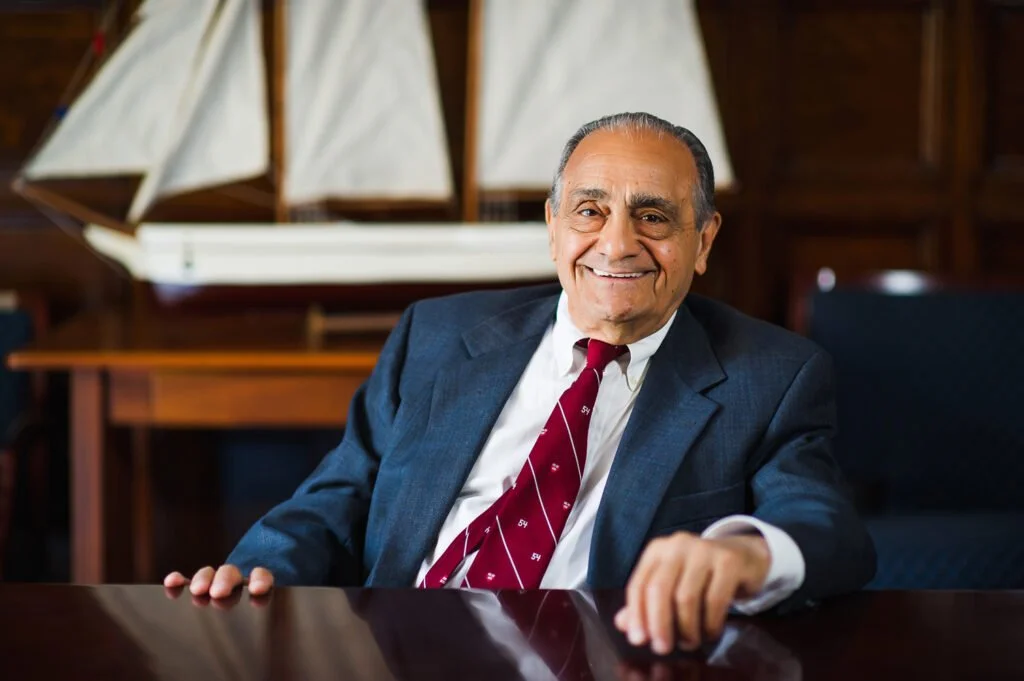
The Richard Melik Simonian Charitable Trust has supported this program since 2021. Armenian graduate students have been indexing the oral history recordings in our collection using time-stamping software that will make them searchable and available as a resource for families and for scholars in the coming year.
Richard “Dick” Simonian (1932-2018), a prominent Worcester attorney and founder of the law firm Simonian and Murray, lived most of his adult life in Worcester, while maintaining a residence in Watertown.
Born in New York City to Rose and Avedis Simonian (both Genocide survivors), he graduated Magna Cum Laude from Harvard College in 1954 and Columbia Law School in 1958. He spent his junior year at the Paris Sorbonne University where he enrolled in French Studies and learned to speak French fluently. He traveled to many other countries and in his later years, enjoyed numerous trips to Armenia.
A proud Armenian, Dick was involved in the Armenian communities of Worcester, Watertown, Washington, and Armenia. In addition to serving on the board of the Armenian Museum of America, he was a trustee of the Society for Orphaned Armenian Relief where he supported individual orphans and their pursuit of higher education.
He worked tirelessly to have the United States recognize and acknowledge the Armenian Genocide. Apart from his serious endeavors, Dick’s love of life, sense of humor, and great storytelling brought joy to those around him, both young and old.
With education being of utmost importance to Dick, in his lifetime he laid the groundwork for the Richard Melik Simonian Charitable Trust to benefit students in the Armenian communities of Massachusetts by providing scholarships to those most in need. The Trust is managed by Christopher R. Mitchell and Michael B. Murray.